

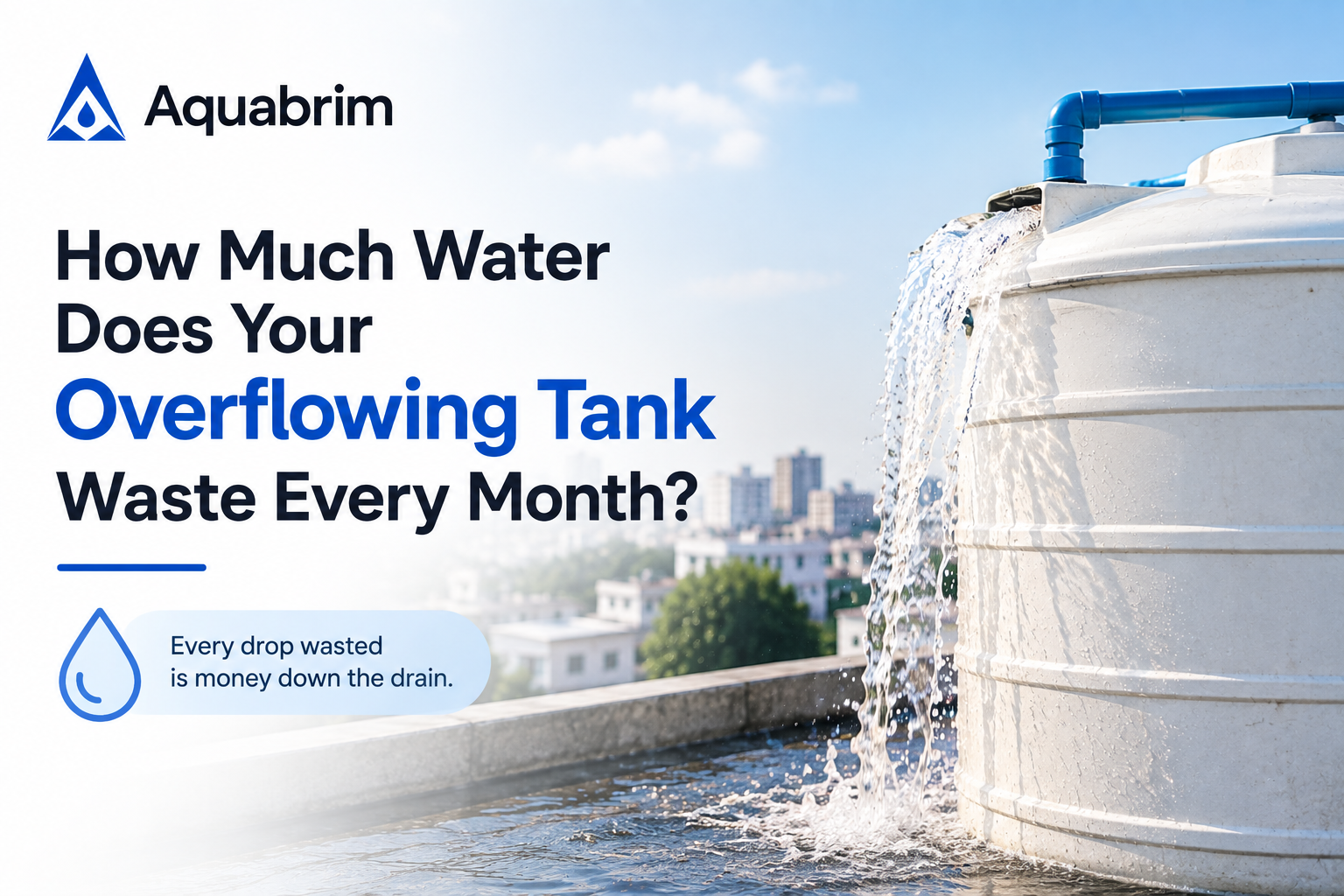
A standard 500-litre overhead tank overflowing once daily wastes roughly 50–150 litres per overflow event, depending on how long the pump runs after the tank is full. Over a month, that adds up to 1,500–4,500 litres of treated, pumped water lost to your terrace or more, if overflow happens multiple times a day. The only way to stop it completely is an automatic water level controller that cuts the pump off the moment the tank is full.
Most people who have dealt with a water tank overflow describe the same experience. They hear the sound of water running on the terrace, go up to check, and find the tank has been overflowing for anywhere from a few minutes to several hours. The pump gets switched off. The water drains away. And the whole thing is quietly forgotten until it happens again.
What rarely gets calculated is how much water that adds up to. Over a month of daily overflow events, the total volume wasted from a standard Indian home tank is not a negligible amount. It is often enough to supply a family's drinking water needs for weeks.
This is a problem with a straightforward solution — an automatic water level controller that stops the pump the moment the tank is full. But before getting to the solution, it is worth understanding exactly what overflow is costing you.
Why Tanks Overflow in the First Place
An overhead tank overflows when the pump continues running after the tank has reached full capacity. This happens because someone forgot to switch the pump off, because a float valve failed to close, or simply because no one was watching the tank when it filled.
In most Indian homes, the pump is controlled manually, someone switches it on when the tank runs low and is supposed to switch it off when the tank is full. The gap between those two actions is where overflow happens. If the pump fills a 500-litre tank in 20 minutes and nobody switches it off for 30 minutes, 10 minutes of overflow has already occurred.
In apartments and housing societies, the problem is compounded because the person responsible for switching the pump often cannot see the tank from the motor panel. They estimate. And the estimate is frequently wrong in the direction of too long rather than too short.
Float valves, the small mechanical floats that are supposed to cut off water flow when the tank is full, can slow overflow but rarely eliminate it. In areas with hard water, calcium and mineral deposits build up on the float mechanism over time, causing it to stick in the open position. When a float valve fails in this way, there is nothing stopping the pump from running indefinitely.
The Real Cost of Overflow — It Is Not Just Water
The volume of wasted water is the most obvious cost, but it is not the only one. Overflow creates a chain of secondary costs that most homeowners do not connect back to the tank.
Electricity Wasted
Every minute the pump runs unnecessarily after the tank is full consumes electricity with no useful output. A standard 0.5 HP domestic pump draws roughly 375 watts. Ten minutes of unnecessary runtime per day adds approximately 1.1 kilowatt-hours per month, a small but real addition to your electricity bill, every month, with no benefit.
For larger pumps in apartment buildings — 1 HP, 2 HP, or more — the unnecessary consumption scales proportionally. A 2 HP pump running unnecessarily for 15 minutes daily wastes roughly 5–6 units of electricity per month across the whole building.
Terrace and Structural Damage
Water consistently flowing across a rooftop terrace is not harmless. Terraces in Indian buildings are waterproofed, but repeated water exposure degrades that waterproofing layer over time. Once it fails, water seeps into the concrete and then into the walls and ceilings below the tank.
The resulting seepage causes paint to peel, plaster to crumble, and in persistent cases, reinforcement bars inside the concrete to rust and expand, a process called spalling that compromises the structural integrity of the roof slab. Repairing seepage-related structural damage typically runs into tens of thousands of rupees per affected area.
The cost of a water level controller that prevents overflow is a small fraction of a single seepage repair. Most homeowners who have dealt with both will tell you the same thing: they wish they had installed the controller first.
Water You Pay For and Never Use
In cities with metered municipal water connections, every litre that enters your building is measured and billed, including the litres that end up on your terrace. In Delhi, the metered tariff for residential consumers sits at ₹5–8 per kilolitre for volumes above the free monthly allocation.
If your home wastes 3,000 litres per month through overflow, you are paying for water that provides zero value to your household. Across a year, that adds up and in cities where water tariffs have been rising steadily, the financial case for stopping overflow only becomes stronger over time.
Who Wastes the Most Water Through Overflow?
Some situations produce far more overflow waste than others.
Homes on municipal supply with unpredictable timing are among the most vulnerable. If water arrives at 4 AM and the pump switches on automatically but needs to be switched off manually, nobody is awake to do it. The pump may run for an hour past full before anyone wakes up and notices.
Homes connected to a borewell face a different version of the problem. The borewell pump delivers water at a consistent rate, and if there is no Macro controller monitoring the tank, the pump keeps running until someone physically switches it off. Borewell pumps are often in isolated locations, a pump room or an outdoor panel, making it even less likely that someone will catch overflow quickly.
Housing societies and apartment buildings with manual motor operation are the single largest source of residential water waste through overflow in India. A building with a 5,000-litre tank overflowing twice daily wastes roughly 1,000 litres per day — 30,000 litres per month because the maintenance staff cannot monitor the tank continuously.
What Overflow Does to Your Building Over Time
The long-term effects of repeated overflow on a building are often invisible until significant damage has already occurred.
Stage one is the loss of waterproofing on the terrace surface. Most Indian rooftop terraces are sealed with a waterproofing compound applied during construction. Repeated water contact, particularly from overflow that accumulates in low areas of the terrace, accelerates the degradation of this seal.
Stage two is seepage into the slab. Once the waterproofing is compromised, water works its way into the concrete through micro-cracks. This appears inside the building as damp patches on the ceiling below the terrace, paint bubbling, and eventually visible water marks.
Stage three is structural damage. Water that reaches the steel reinforcement inside the concrete slab causes it to rust. Rust expands in volume, creating internal pressure that cracks the concrete, chunks of material eventually detach from the ceiling or wall surface. This is a structural issue that requires major repair work, not just repainting.
In buildings where overflow has been occurring daily for years, stage-two seepage is almost always present.
How an Automatic Water Level Controller Stops Overflow Completely
An automatic water level controller eliminates overflow at the source. A wireless sensor inside the overhead tank measures the water level continuously and sends that reading to a control unit near the motor. The moment the tank reaches full capacity, the controller cuts power to the pump, before a single litre can overflow.
Unlike a float valve, which is mechanical and subject to wear and mineral buildup, an electronic water level controller has no moving parts that can jam or corrode. The sensor sits inside the tank and communicates wirelessly with the controller, no cables between the tank and the motor panel.
For homes on municipal supply, Aquabrim's Trigger controller detects when water pressure arrives in the supply line and starts the motor automatically, then stops it when the tank is full. For borewell homes, the Macro monitors both the source and the tank. For buildings with multiple tanks, the Matrix manages the entire system from one controller.
The result is a home where overflow simply does not happen, not because someone is watching the tank, but because the system does not allow the pump to run past the point where the tank is full.
Is a Water Level Controller Worth the Cost?
Consider the numbers for a standard home with a 500-litre tank overflowing once daily. The water wasted is roughly 2,250 litres per month. The electricity wasted running the pump unnecessarily is approximately 1–1.5 units per month. The long-term seepage risk adds a potential repair cost of tens of thousands of rupees if left unaddressed.
A quality wireless water level controller from Aquabrim costs between ₹3,000 and ₹10,000 depending on the model. Installation is a few hours by a qualified electrician. Once installed, the system operates automatically for 8 to 12 years with minimal maintenance, only the sensor batteries need replacing every four years.
Against the ongoing cost of wasted water, wasted electricity, and accumulating structural risk, the investment recovers itself relatively quickly. But the more compelling argument for most homeowners is not financial. It is the simple peace of mind of knowing the tank will never overflow again.
Conclusion
The water your overhead tank wastes through overflow every month is not a trivial amount. For most Indian homes it runs into thousands of litres, water that has been pumped, treated, delivered to your building, and paid for, but never used.
The financial cost of that waste is real. The structural cost in the form of terrace seepage and long-term building damage is often larger, and harder to reverse. And in a country where water availability is under increasing pressure across major cities, the environmental case for stopping needless waste adds another dimension.
An automatic water level controller is the only solution that addresses all of these costs simultaneously and permanently. It costs a fraction of what most people spend on a single seepage repair, and it works without anyone having to remember to do anything.
Ready to stop manually managing your tank?
Aquabrim makes smart water level controllers for every home setup, municipal supply, borewell, or multiple tanks. Trusted by 50,000+ homes across India.
FAQ
Frequently Asked Questions
It depends on the tank size and how often overflow happens. A standard 500-litre home tank overflowing once a day typically loses 50–150 litres per event around 1,500 to 4,500 litres per month. Larger tanks and more frequent overflow multiply that significantly. The most accurate way to estimate your loss is to measure how long your pump runs after the tank is full and multiply by your pump's flow rate.
The most common reason is that the pump is not switched off quickly enough when the tank reaches full capacity. This happens when no one is monitoring the tank at the time the pump finishes filling it, or when a basic float switch fails to shut off the pump reliably. An automatic water level controller solves this by stopping the pump the moment the tank reaches its set full level, regardless of whether anyone is watching.
Yes, and often more than people realise. Water consistently spilling onto a terrace or rooftop seeps into the concrete over time, causing dampness, fungal growth, paint peeling, and in serious cases, structural damage to walls and ceilings below the tank. The repair costs for seepage-related damage can far exceed the cost of a water level controller.
An automatic water level controller is the only permanent solution. It uses a sensor inside the tank to measure the water level continuously and stops the pump automatically when the tank is full. Unlike a float switch, which can jam or wear out, a modern wireless water level controller is reliable, maintenance-free, and works without any cables between the tank and the motor panel.
The financial cost depends on your local water tariff. In Delhi, the metered rate for water is ₹5–8 per kilolitre for residential consumers. If your home is wasting 3,000 litres per month through overflow, the direct water cost is roughly ₹15–25 per month. But the real financial impact is the additional electricity cost of running the pump longer than necessary, and the long-term building repair costs from terrace seepage and dampness.
A float valve can reduce overflow but cannot eliminate it reliably over time. Float valves are mechanical devices that can get stuck in the open position due to mineral deposits, corrosion, or physical wear especially in areas with hard water. When a float valve fails, water overflows freely until someone notices. An electronic water level controller is more reliable and does not suffer from the same failure modes.
It uses a wireless sensor inside the tank to monitor the water level in real time. When water reaches the set full level, the controller switches the motor off immediately before the water can overflow. The system works automatically, 24 hours a day, without requiring any human action.
In most Indian cities, water from the municipal supply is metered at the point it enters your building. This means that water lost to overflow has already been measured and charged at the metered rate. You pay for every litre that enters your building including the litres that end up on your terrace rather than in your taps.