

Top Benefits of a Water Automation System for Buildings | Aquabrim
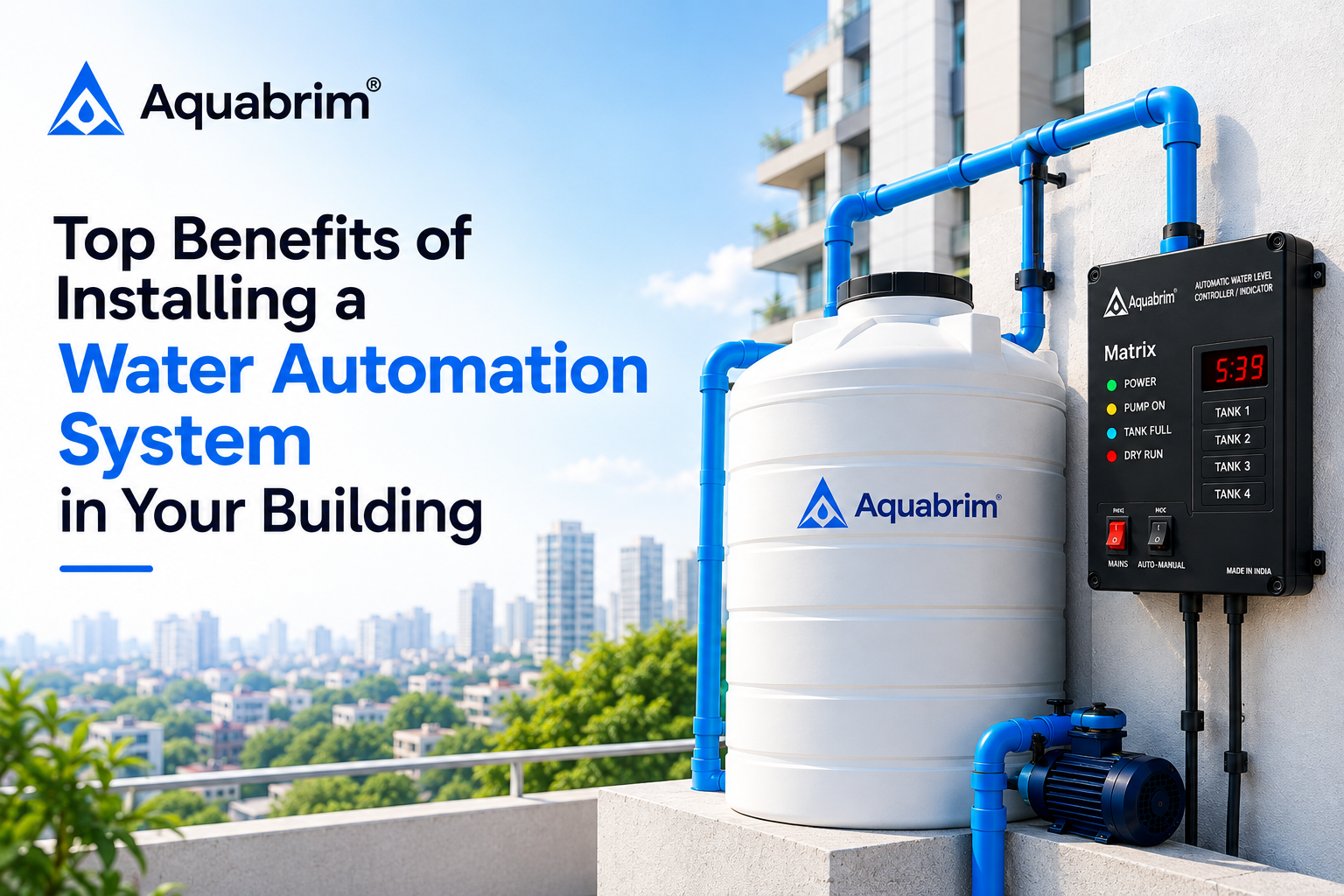
A water automation system automatically monitors your tank levels and controls your motor stopping it when tanks are full, starting it when they run low, and protecting the motor from dry run. The top benefits include: no tank overflow, no motor burnout, lower electricity bills, balanced water supply across all floors, zero dependency on manual staff, and real-time monitoring from your phone. It works for homes, apartments, housing societies, and commercial buildings of any size.
Managing water manually in a building, whether a single home, an apartment complex, or a commercial property, means someone is responsible for switching the motor on and off at the right time, every single day. When that does not happen perfectly, tanks overflow, motors run dry, electricity is wasted, and maintenance costs pile up. A water automation system removes all of that from the equation entirely.
In India, where water supply timing is often unpredictable and buildings increasingly rely on multiple water sources, the case for automation has moved well beyond convenience. It has become a practical necessity for any building that wants consistent water supply, lower operating costs, and minimal maintenance dependency.
This blog covers every significant benefit of installing a water automation system, from the immediate and obvious to the ones most building managers do not think about until they have experienced the alternative firsthand.
1. No More Tank Overflow
Overflow is the most visible and most common water management problem in Indian buildings. When the motor runs longer than it should, water spills onto the terrace, runs down walls, and seeps into the structure below. As we covered in our blog on how much water your overflowing tank wastes , a single overflow event wastes hundreds of litres and daily overflow adds up to thousands of litres every month.
A water automation system eliminates this completely. The sensor inside the tank monitors the water level in real time. The moment the water reaches full capacity, the controller switches the motor off, before a single litre can overflow. The system does not guess, does not rely on human memory, and does not depend on someone being awake at 4 AM when the municipal supply arrives.
For housing societies and apartment buildings where maintenance staff cannot monitor every tank continuously, this is one of the most impactful benefits of automation and the one residents notice first.
2. Complete Motor Dry Run Protection
Motor dry run where the pump continues operating without water in the source, is one of the most expensive and avoidable water management failures in Indian homes and buildings. A motor running dry overheats rapidly and can burn out in minutes. Replacing a submersible or monoblock pump costs anywhere from ₹5,000 to ₹25,000 depending on capacity, and the building goes without water during the repair.
A water automation system solves this at the source level. The Macro automatic water level controller for Borewell , for example, monitors both the underground sump or borewell and the overhead tank. If the source water level drops below a safe threshold, the controller stops the motor before it can run without water. The protection is automatic and continuous, it works whether anyone is present or not.
For buildings relying on borewell supply, where underground water levels fluctuate seasonally and with usage, this protection is not a nice-to-have feature. It is the difference between a motor that lasts ten years and one that needs replacement every two.
3. Lower Electricity Bills Every Month
Electricity consumption from water pumps is a significant and often overlooked line item in building operating costs. A standard domestic pump draws 375 to 1,500 watts depending on its capacity. When that pump runs longer than necessary, because no one switched it off at exactly the right moment, every extra minute consumes electricity with no useful output.
In manually managed buildings, this unnecessary runtime is not occasional. It is daily. A pump that runs 15 minutes past full, every day, for a 1 HP motor, wastes roughly 4 to 5 units of electricity per month. Multiply that across a housing society with multiple pumps and multiple tanks, and the unnecessary electricity cost becomes substantial.
A water automation system stops the pump at precisely the right moment, the moment the tank is full. No extra minutes, no wasted electricity. Over a year, the electricity savings from automation frequently amount to more than the cost of the system itself.
4. Balanced Water Distribution Across All Floors
In multi-storey buildings without automation, water distribution is rarely balanced. The tanks that are easiest to monitor tend to get filled first and most reliably. Tanks on higher floors, or in less accessible locations, are more likely to run low because they depend on someone remembering to check and switch the pump at the right time.
The result is what residents in many Indian apartment buildings experience daily — good water pressure on the lower floors, inadequate pressure or actual shortage on the upper floors, even when the building has adequate water overall.
A water automation system addresses this through controlled, sequenced tank filling. Products like the Matrix Multi Tank Controller manage multiple tanks simultaneously from a single control unit, filling each according to set priorities and stopping each pump at exactly the right level. Every tank in the building gets filled correctly, and every floor gets consistent supply. As we explain in our blog on how to manage multiple water tanks automatically , this coordination is what transforms a building's water reliability from inconsistent to predictable.
5. Zero Dependency on Manual Staff for Daily Water Management
In housing societies and apartment complexes, water management is one of the most time-consuming daily responsibilities of maintenance staff. Switching the motor on when supply arrives, monitoring tank levels, remembering to switch off, handling complaints about shortage on specific floors, these tasks occupy hours of staff time every day.
That dependency creates several problems. Water management suffers on weekends, during staff leave, and during night hours when no one is on duty. New staff members make mistakes. Experienced staff are occupied with tasks that do not require their skill level. The building's water reliability becomes tied to individual human attention rather than a reliable system.
A water automation system removes this dependency entirely. Once installed, the system manages routine water operation automatically, filling tanks, stopping pumps, protecting motors, and balancing supply, without any human involvement. Staff time is freed for tasks that actually require human judgment.
6. Real-Time Remote Monitoring and Alerts
One of the significant advances in modern water automation is visibility. Older controllers operated automatically but gave building managers no insight into what was actually happening with the water system. You only found out something was wrong after the tank was already empty or a pump had already burned out.
Today's water automation systems, built around IoT connectivity, change this fundamentally. Aquabrim's IoT Gateway connects the water management system to a mobile app and web platform, giving building managers and homeowners real-time visibility into tank levels, motor status, and system alerts from any device, from anywhere.
The practical implications of this are significant. A housing society manager can check whether the overnight pump cycle completed correctly from their phone at 7 AM, without going to the pump room. A homeowner travelling out of the city can confirm the tank is at full level before a long trip. Maintenance staff receive an alert the moment a sensor detects a problem, before it becomes a crisis.
For large buildings with multiple tanks and multiple pumps, this real-time visibility is what allows centralised management without the need for constant physical presence at each pump point.
7. Prevention of Terrace and Structural Damage
The structural consequences of repeated tank overflow are something most building managers do not connect to water management until the damage becomes visible and expensive. Water consistently spilling onto a rooftop terrace degrades the waterproofing layer, works its way into the concrete slab, reaches the steel reinforcement, and causes rust-driven cracking, a process called spalling, that requires major structural repair.
By the time seepage appears as damp patches on the ceiling below the terrace, the waterproofing has already failed. By the time concrete cracking occurs, the repair bill is typically in the range of tens of thousands of rupees per affected area.
A water automation system prevents overflow from occurring at all, which means the terrace stays dry, the waterproofing remains intact, and the structural risk never develops. The cost of the system is a small fraction of a single seepage repair, and it eliminates the cause of the problem permanently rather than addressing its symptoms.
8. Accurate Water Usage Tracking and Billing
For housing societies and commercial buildings where water is a shared resource, fair and accurate billing has historically been difficult. Without measurement, common practice is to charge a flat rate per unit, which is neither fair to low-consumption residents nor an incentive for efficient use.
A complete water automation system can incorporate a flow meter at individual supply points, measuring exactly how much water each unit or zone consumes. This makes accurate per-unit billing possible, gives residents visibility into their own consumption, and creates a direct financial incentive to use water efficiently.
In large residential complexes and commercial buildings, accurate water metering typically reduces overall consumption, because residents and tenants who can see their usage and are billed accordingly use water more thoughtfully than those on a flat rate.
9. Works for Every Type of Building and Water Source
One of the reasons water automation has become practical for the full range of Indian buildings, from single homes to large commercial complexes, is that modern systems are designed with specific configurations for different water sources and building types.
For homes on municipal supply, the Trigger water level controller for municipal supply detects when water pressure arrives in the line and starts the motor automatically ensuring the supply window is never missed regardless of what time it arrives. For borewell homes, the Macro monitors the source and the tank. For buildings with multiple tanks, the Matrix manages the full system from a single controller. For setups that need monitoring without full automation, the Flexibell provides wireless alerts without controlling the motor.
This product-per-setup approach means a water automation system can be correctly matched to the actual water configuration of any building rather than fitting one generic product into situations it was not designed for.
10. Long-Term Reliability with Minimal Maintenance
A water automation system is not a product that requires ongoing attention or regular servicing to function correctly. Wireless sensors run on battery lasting more than four years. The control unit has no moving parts and connects permanently to the motor circuit. Once installed and configured, the system runs in the background without needing human oversight for routine operation.
This is distinct from mechanical float valves and manual systems, which require periodic cleaning, replacement of worn parts, and ongoing adjustment. A quality wireless water automation system from Aquabrim is rated for 8 to 12 years of reliable operation, significantly longer than the interval between most building maintenance cycles.
For building managers and RWA committees evaluating the total cost of water management over a five or ten-year horizon, the low maintenance requirement of a water automation system is a significant advantage over alternatives that require regular service or replacement.
Which Buildings Benefit Most from Water Automation?
Virtually any building with an overhead tank and a motor benefits from automation. The benefit is proportional to the complexity of the water system and the consequences of manual management failure. Here is where the impact is highest:
- Apartments and housing societies — where multiple tanks, unpredictable supply, and staff-dependent management create daily reliability problems. This is where automation delivers the most visible immediate improvement.
- Borewell-dependent homes — where motor dry run is a constant risk and source-level monitoring is essential. The cost of a single motor replacement exceeds the cost of the automation system.
- Hotels and commercial buildings — where water continuity affects guest experience and business operations, and where management at scale makes manual methods impractical.
- Homes on unpredictable municipal supply — where missing the morning supply window is a recurring problem that automation eliminates permanently.
Conclusion
The benefits of installing a water automation system in your building are not limited to convenience. They extend to structural protection, financial savings, motor longevity, staff efficiency, and environmental impact. The combination of no overflow, no dry run, lower electricity bills, and consistent water supply addresses every major water management problem that Indian buildings face, simultaneously and permanently.
If your building currently relies on manual motor switching, float valves, or staff-dependent water management, the gap between what you have and what a properly installed water automation system delivers is significant, and the investment required to close that gap is modest relative to the savings it generates.
Explore Aquabrim's full range of water level controller products to find the right system for your building setup, or Contact Aquabrim directly to get a recommendation tailored to your specific water source and building configuration.
Ready to stop manually managing your tank?
Aquabrim makes smart water level controllers for every home setup, municipal supply, borewell, or multiple tanks. Trusted by 50,000+ homes across India.
FAQ
Frequently Asked Questions
A water automation system is a combination of sensors, controllers, and pump interfaces that monitors your water tank levels and automatically manages pump operation, filling tanks when needed and stopping the pump when full. It removes the need for manual switching and prevents overflow, dry run, and uneven water distribution.
The main benefits are: no more tank overflow, no more motor dry run, lower electricity bills from reduced unnecessary pump runtime, balanced water supply across all floors, zero dependency on manual staff for routine water management, and real-time monitoring from a mobile app.
Yes. Multi-tank automation systems like the Aquabrim Matrix are specifically designed to manage several tanks simultaneously from a single control unit. Each tank has its own wireless sensor, and the controller coordinates pump operation across all tanks to ensure balanced and efficient filling.
Yes. A water automation system ensures the pump only runs as long as it needs to and stops precisely when the tank is full. This eliminates unnecessary pump runtime, which in manually managed buildings often runs 10 to 30 minutes longer than required every day, directly reducing monthly electricity consumption.
Yes, and it is particularly important for borewell homes. A borewell automation system monitors not just the overhead tank but also the underground source. If the borewell runs low, the system stops the motor before it can run dry,preventing the motor burnout that is one of the most common and expensive water-related repairs in Indian homes.