

Which Water Level Controller Should You Choose? A Complete Buying Guide
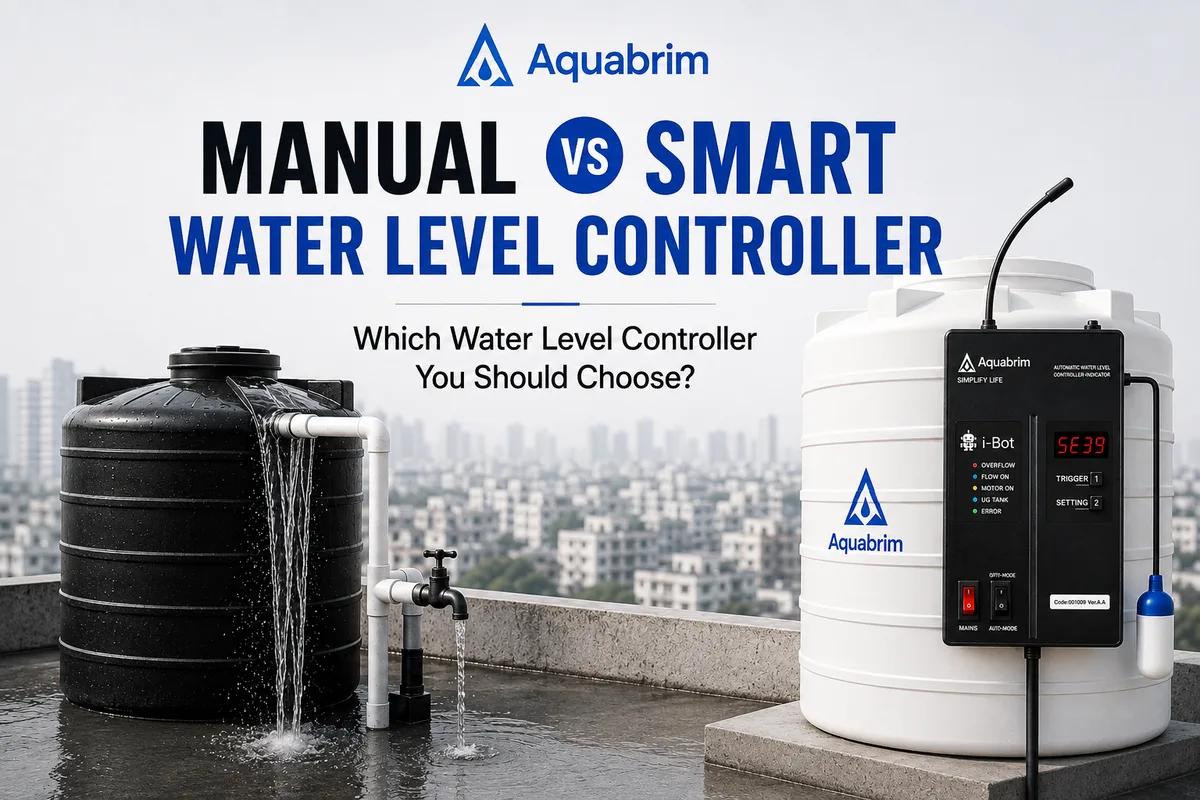
A water level controller is a device that automatically monitors your tank level and controls your motor — so it switches on when water runs low and switches off when the tank is full. The right type depends on your water source: municipal supply, borewell, or multiple tanks. This guide explains every type, who needs what, and exactly what to check before you buy.
If you have ever come home to a tank that has been overflowing for hours, or woken up to no water because the motor ran dry overnight, you already understand the problem a water level controller is supposed to solve.
The harder question is which one. Walk into any electrical store or search online and you will find options ranging from a few hundred rupees to fifteen thousand. Some are mechanical, some wireless, some app-controlled. Each works differently, and each is suited to a specific type of home or water setup.
This guide cuts through the confusion. By the time you finish reading, you will know exactly which type fits your home, what features actually matter, and what mistakes to avoid before spending a single rupee.
What Is a Water Level Controller?
A water level controller is a device that monitors the water level in your tank and automatically controls your motor based on what it detects. When the tank runs low, it starts the motor. When the tank is full, it stops the motor.
That sounds simple, and the basic concept is. But the technology behind it, and what it can do beyond basic on/off switching, varies significantly depending on the type you choose.
A good water level controller eliminates two of the most common and expensive water problems in Indian homes:
- Tank overflow — water spilling onto your terrace or seeping through walls because no one switched the motor off in time
- Motor dry run — the pump running without water in the source, which causes it to overheat and burn out within minutes
A quality controller prevents both, automatically, without you having to think about it.
Why Every Home, Apartment and Commercial Building Needs One
Most Indian homes still manage water the same way they did twenty years ago: someone checks the tank, someone remembers to switch the motor, and when that does not happen, something goes wrong.
The scale of the problem is larger than most people realise. Motor burnouts from dry run are among the most common and avoidable appliance repair costs in Indian households. Water overflow on terraces causes seepage, structural damage, and wasted water, in a country where water scarcity is a genuine and growing concern in cities like Delhi, Bengaluru, and Chennai.
For commercial buildings and housing societies, the stakes are even higher. A building with three tanks and two borewells, managed manually, is a constant source of maintenance problems. A properly installed water level controller for apartment complexes removes most of that management burden permanently.
The question is not really whether you need one. The question is which one is right for your specific setup.
Different Types of Water Level Controllers
There are five main types available in India. Each uses a different technology and suits a different situation.
Float Switch Water Level Controller
The float switch is the oldest and most basic type. A mechanical float sits on the water surface and physically opens or closes an electrical contact as the water level rises or falls.
It works, but with limitations. The float can get stuck in a fixed position due to mineral deposits or physical obstruction, leaving your motor running when it should be off, or off when it should be on. It also offers no dry-run protection, no alerts, and no remote monitoring.
Float switches are suitable for very basic single-tank setups where reliability requirements are low and budgets are tight. For anything more demanding, they fall short.
Electrode-Based Water Level Controller
Electrode-based controllers use metal probes inserted at different heights inside the tank. When water touches a probe, it completes a circuit and the controller responds accordingly.
These are more reliable than float switches and were the standard technology for many years. The main drawback is that hard water, which is common across much of India, causes mineral deposits to build up on the probes over time, reducing accuracy and eventually requiring cleaning or replacement.
They work well in areas with soft water and are still a practical choice for standard residential setups where maintenance is manageable.
Ultrasonic Water Level Controller
Ultrasonic controllers measure water level using sound waves. The sensor is mounted above the water surface and sends a pulse downward, and the time it takes to reflect back tells the system exactly how full the tank is.
Because the sensor never touches the water, there is no mineral buildup or corrosion. Accuracy is high. These are particularly well suited to tanks where hygiene matters, since there is no contact between the sensor and the stored water.
The trade-off is cost — ultrasonic sensors are more expensive than electrode-based options — and the need for careful installation to avoid false readings from tank walls or fittings.
Wireless Water Level Controller
Wireless controllers replace the cable between the tank sensor and the motor panel with a radio signal. The sensor sits inside the tank and communicates wirelessly with the control unit mounted near your motor, with no cables required between the two.
This is now the most practical choice for the majority of Indian homes. Running cables from a rooftop tank to a ground-floor motor panel typically means cutting through walls, running conduit across open terraces, and significant installation work. Wireless systems avoid all of that.
Modern wireless controllers are highly reliable, work through walls and floors, and are designed to handle the interference and range requirements of typical Indian residential buildings. A quality wireless water level controller typically covers 30 to 100 metres, which is sufficient for most homes and apartment buildings.
IoT-Based Smart Water Level Controller
IoT controllers take automation further by connecting to your WiFi and a mobile app. You can see tank levels in real time, receive alerts when the tank is low or overflowing, check motor status, and in some systems start or stop the motor remotely, all from your phone.
For homeowners who travel, residents whose tank is on an inaccessible rooftop, and facility managers overseeing multiple buildings, this visibility is genuinely valuable. You stop finding out something went wrong after it already has.
IoT controllers are the fastest-growing segment of the water automation market in India, and for good reason: the additional cost is modest relative to the peace of mind they provide.
The Five Types Compared at a Glance
| Type | Technology, best use, reliability and cost |
|---|---|
| Float Switch | Mechanical float. Best for basic single-tank homes. Reliability: medium, can get stuck. Cost: ₹300–800. |
| Electrode-Based | Metal probes in the water. Best for older apartment buildings. Reliability: medium, mineral buildup over time. Cost: ₹600–1,500. |
| Ultrasonic | Sound waves, no contact with water. Best for clean water tanks and high accuracy needs. Reliability: high, no physical contact. Cost: ₹2,000–6,000. |
| Wireless | Radio signal between sensor and controller. Best for any home where wiring is not possible. Reliability: high, modern and durable. Cost: ₹3,000–10,000. |
| IoT / Smart | WiFi plus mobile app. Best for tech-savvy users and remote monitoring. Reliability: very high, full visibility. Cost: ₹5,000–15,000+. |
Which Water Level Controller Is Best for Different Applications?
The right controller depends on your water source, the number of tanks you have, and the complexity of your setup. Here is a practical breakdown:
| Setup and water source | Recommended type and key requirement |
|---|---|
| Individual home or villa on municipal supply | Wireless or IoT controller. Key requirement: capture water the moment supply arrives. |
| Individual home or villa on borewell | Wireless with dry-run protection. Key requirement: the motor must stop when the source runs low. |
| Apartment with a single tank (municipal or borewell) | Wireless automatic controller. Key requirement: simple, cable-free, automatic operation. |
| Housing society or RWA on municipal plus borewell | Multi-tank IoT controller. Key requirement: centralised control of the entire system. |
| Commercial building on municipal plus borewell | Industrial-grade IoT system. Key requirement: remote monitoring, alerts and logs. |
| Factory or industry with multiple sources | SCADA-compatible IoT controller. Key requirement: integration with existing plant systems. |
If you are unsure which category your home falls into, the safest starting point is a wireless controller with dry-run protection: it covers the most common residential scenarios and avoids the most expensive mistakes.
Factors to Consider Before Choosing a Water Level Controller
Before you decide, work through these eight questions. Your answers will narrow the field considerably:
| Factor | What to check, and why it matters |
|---|---|
| Water source | Municipal supply, borewell, or both? This determines which controller type fits. |
| Number of tanks | One overhead tank or multiple? Multi-tank setups need a system controller, not a basic unit. |
| Wiring feasibility | Can cables run between the tank and the motor? If not, wireless is the only practical option. |
| Motor type | Monoblock, submersible, or centrifugal? The controller must be compatible with your motor specifications. |
| Dry-run protection | Is the borewell source level monitored? Without this, motors burn out when the source runs dry. |
| Remote monitoring | Do you need app-based alerts? IoT models add visibility; basic models do not. |
| Budget | One-time cost against long-term value. Cheaper units cost more in maintenance and motor repairs. |
| Brand and warranty | Is after-sales support available in India? A local brand with a service network matters for longevity. |
One factor that is often overlooked: after-sales support. A controller that breaks down six months after installation is only useful if someone can fix it. Choose a brand with a service network and a clear warranty policy, especially for installations in cities where the brand has an established presence.
Aquabrim's Water Level Controller Solutions
Aquabrim has been building water level controllers for Indian homes and industries since 2008. Rather than offering one product for every situation, Aquabrim's approach is to make a dedicated system for each type of water setup. Here is where each product fits:
Matrix Multi Tank Controller — For Buildings with Multiple Tanks
The Matrix Multi Tank Controller is designed for housing societies, commercial buildings, and any installation where more than two tanks need to be managed from a single system. Instead of installing separate controllers for each tank, the Matrix manages the entire setup, including pumps, tanks, and sources, from one central unit.
It is the practical choice for RWAs and facility managers who currently manage water manually across multiple tanks.
Macro Borewell Water Controller — For Borewell and Submersible Pump Homes
The borewell water level controller Macro monitors both the underground source and the overhead tank. If the source water runs too low, it stops the motor before dry-run damage can occur. For homes on borewell or submersible pump, this is the essential feature that basic controllers miss entirely.
Anyone who has paid for a motor burnout repair will immediately understand why this matters.
Trigger Municipal Water Controller — For Municipal Supply Homes
The municipal water controller Trigger is built for homes where water arrives on an unpredictable schedule, typically early morning or at odd hours. It detects when water pressure arrives in the supply line and automatically starts the motor, without requiring anyone to be awake or present.
This is particularly relevant for homes in Delhi, Noida, Gurgaon, and other cities where municipal supply timing is inconsistent and missing it means waiting another day.
Flexibell Water Level Alarm — For Monitoring Without Full Automation
The water level alarm Flexibell is for setups that need water level awareness and alerts but not full motor automation. It sends wireless alerts when the tank reaches a set level, useful for homes where motor control is manual but you want to stop relying on someone physically checking the tank.
Wireless Water Level Transmitter — For Precise Level Measurement
The wireless water level transmitter provides continuous, accurate level readings transmitted wirelessly. It is particularly suited to industrial and commercial applications where knowing the exact percentage of tank capacity at any moment is necessary for operations or billing purposes.
All Aquabrim products use wireless sensor technology, connect to the Aquabrim mobile app for remote monitoring, and are backed by the company's 16+ years of installation experience across homes, hotels, government facilities, and industrial plants in India.
Common Mistakes People Make While Choosing a Water Level Controller
Most buying regrets in this category come from one of five predictable mistakes. Knowing them in advance costs nothing:
| Common mistake | Why it goes wrong, and what to do instead |
|---|---|
| Buying on price alone | Cheap controllers often lack dry-run protection, leading to motor burnout within months. Instead: compare features first, then price, and calculate total cost including maintenance. |
| Using one controller for multiple tanks | A single-tank controller does not manage two or three tanks effectively. Instead: use a multi-tank system like a matrix controller for buildings with more than one tank. |
| Ignoring wiring requirements | Running cables from a rooftop tank to a ground-floor motor panel is expensive and invasive. Instead: choose wireless from the start, which saves installation cost and avoids wall cutting. |
| Wrong controller for borewell | Municipal supply controllers do not monitor source water, so the motor runs dry and burns out. Instead: for borewell, always choose a controller with source-level monitoring and dry-run cutoff. |
| Not using app-based monitoring | Users do not know if the system is working until the tank is already empty or overflowing. Instead: IoT controllers with alerts give you real-time status from anywhere, worth the extra cost. |
Conclusion
The water level controller market in India has evolved significantly in the last decade. What used to be a choice between a basic float switch and a slightly less basic electrode unit is now a choice between genuinely capable systems: wireless, app-connected, multi-tank, and built with Indian water conditions in mind.
The right choice comes down to your water source, your tank configuration, and how much visibility you want into your water system. For most Indian homes today, a wireless controller with dry-run protection covers the essential bases. For more complex setups, such as borewells, multiple tanks, or commercial buildings, a dedicated system designed for that specific use case will perform far better and cost less in the long run.
Take ten minutes to answer the eight questions in the factors table above. You will know which category you fall into, and the right product will become obvious.
Every home has a different water setup, and the right choice depends on your source, your tanks, and your building. Aquabrim's team can help you pick the correct system in minutes. See all water level controllers or talk to the team.
Ready to stop manually managing your tank?
Aquabrim makes smart water level controllers for every home setup, municipal supply, borewell, or multiple tanks. Trusted by 50,000+ homes across India.
FAQ
Frequently Asked Questions
A float switch is a basic mechanical device that opens or closes a circuit based on water level. A water level controller is a complete system that includes sensors, a control unit, and often dry-run protection, time delay, and remote monitoring features. Float switches can jam or wear out; modern controllers are electronic and far more reliable.
For a borewell or submersible pump setup, you need a controller with source-level monitoring and dry-run protection. The controller must monitor the underground source, not just the overhead tank, and stop the motor automatically if the source water runs too low. A standard single-tank controller is not sufficient for a borewell setup.
Yes. Wireless controllers use radio signals between the sensor in the tank and the control unit near the motor, so no cables are required between the two points. This is the main reason wireless controllers are preferred in homes where running cables through walls or across terraces is impractical.
An IoT controller connects to your home WiFi and sends real-time data to a mobile app. You can check the tank level, see whether the motor is running, and receive alerts for overflow risk or dry-run conditions, from anywhere. Some systems also allow you to manually start or stop the motor from the app.
Dry-run protection stops the motor automatically when the water source (borewell or sump) runs too low, preventing motor burnout. If you are on a borewell or submersible pump, dry-run protection is essential — without it, the motor can burn out within minutes of running dry, costing thousands in repairs.
Yes, but you need a multi-tank or matrix controller rather than a basic single-tank unit. A matrix-type controller manages multiple tanks and pumps from a single system, which is far more practical and cost-effective for housing societies and commercial buildings than installing individual controllers for each tank.
A quality wireless water level controller from a reputable brand typically lasts 8 to 12 years with minimal maintenance. The wireless sensor and control unit are sealed electronic components with no moving parts, making them more durable than mechanical float switches that require periodic cleaning and replacement.
Check your water source type (municipal or borewell), number of tanks, motor type and capacity, wiring feasibility, and whether you need remote monitoring. Also verify that the brand offers after-sales support and a warranty of at least one year. Buying on price alone is the most common mistake — the cheapest options often lack dry-run protection.